
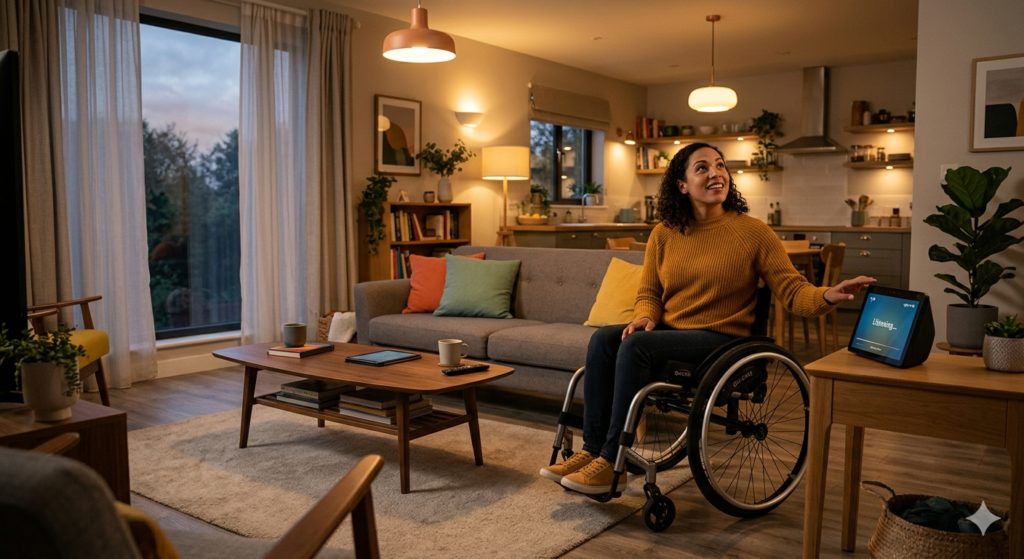
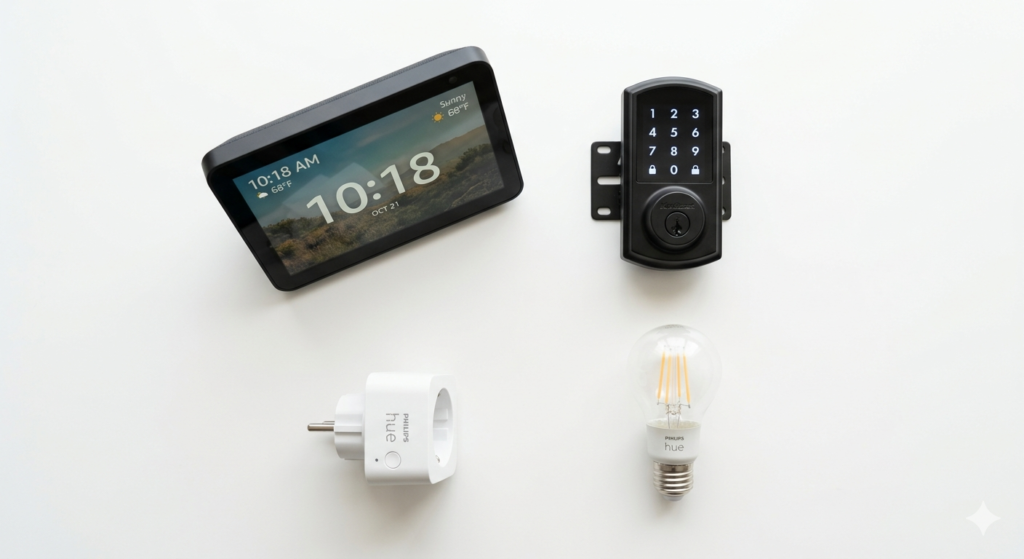
Quick Answer: The Amazon Echo Show 8 is the single most impactful smart home device for most disability categories. It combines voice control, visual display, video calling, medication reminders and Drop In welfare checks in one device. Pair with smart plugs, bulbs and keypad lock for a complete setup under $300.
1. How Smart Home Technology Transforms Daily Living
Smart home technology has a unique role in accessibility that goes beyond convenience. For a person with limited mobility, a voice-controlled light switch is not a luxury — it is independence. For someone with a visual impairment, a smart speaker that reads the news, sets medication reminders and calls family is a fundamental quality of life improvement.
The core value is eliminating physical interaction requirements. Traditional home tasks — switching lights, adjusting temperature, locking doors, answering phones — require physical interaction. Smart home technology replaces these with voice commands, automated schedules and remote app control.
Important Note: This guide provides general information. Every individual has different needs. We recommend consulting an occupational therapist alongside this guide for your specific situation.
2. Best Devices for Mobility Impairments
Amazon Echo (4th Gen) — Voice Control Hub
The Amazon Echo is the most impactful single purchase for mobility-impaired users. Voice commands replace physical interaction with lights, thermostats, plugs, TVs, locks and phones. Key uses: turning lights on without reaching a switch, adjusting thermostat without approaching the wall, calling family hands-free, setting medication reminders, controlling TV without a remote, and emergency assistance via “Alexa, call for help”.
Amazon Echo (4th Gen) — best voice control hub — ~$90-100
Smart Plugs — Turn Any Device Smart
Smart plugs transform any electrical device into a voice-controlled device. A lamp, fan, coffee maker or phone charger plugged into a smart plug becomes controllable by voice without physical interaction.
Kasa Smart Plug EP25 — 4-pack with energy monitoring — ~$60-80
Smart Lock With Keypad — Keyless Door Access
For wheelchair users and people with limited hand strength, traditional keys require grip and fine motor control that can be genuinely difficult. Smart locks with keypad entry eliminate all three requirements. Auto-lock means the door secures without any manual action.
Schlage Encode Plus — Grade 1 security, keypad, auto-lock — ~$220-250
Wyze Lock + Keypad — best budget keyless entry — ~$100-130
Smart Thermostat — Climate Without Reaching
Thermostat controls are typically mounted at heights requiring standing and reaching. A smart thermostat with voice control eliminates the need to approach the thermostat. Temperature adjustments happen by voice from anywhere in the room.
Google Nest Thermostat — voice controlled, schedule based — ~$100-130
3. Best Devices for Visual Impairments
Amazon Echo Show 8 — Screen Reader + Visual Alerts
The Echo Show 8 is the most complete smart home device for visually impaired users. It combines Alexa voice assistant with a large touchscreen, enabling users with partial vision to use both voice and enlarged visual interfaces. The screen displays caller names, shows weather visually, and presents reminder text alongside audio.
Amazon Echo Show 8 (3rd Gen) — large display, visual alerts — ~$130-150
Smart Lighting With Colour and Brightness Control
For users with low vision or light sensitivity, programmable smart lighting delivers significant practical value. Lights can be set to specific colour temperatures that minimise eye strain. Voice control means adjusting lighting never requires locating physical switches.
Apple HomeKit, full colour control by voice — ~$35-45 per bulb
4. Best Devices for Hearing Impairments
Smart Doorbell With Visual Alert
Standard doorbells are audio-only. For deaf or hard of hearing users, a smart doorbell provides visual alternatives: motion detection alerts on screen, live camera preview, and two-way video communication. Ring Video Doorbell integrates with Amazon Echo Show to display live camera feed automatically when someone presses the bell.
Ring Video Doorbell 4 — visual alerts, two-way video — ~$100-130
Smart Smoke Alarm With App Alert
Traditional smoke alarms are audio-only. Smart smoke alarms send push notifications to all registered devices simultaneously — phone, tablet, smartwatch — providing visual and haptic alert even when audio cannot be heard.
Google Nest Protect Smart Smoke and CO Alarm — ~$110-130
5. Best Devices for Cognitive and Memory Conditions
Dementia, TBI, ADHD, and other cognitive conditions create challenges around routine management, safety and independence. Smart home devices address these through automation, reminders and monitoring.
Amazon Echo — Medication and Daily Reminders
Multiple daily reminders can be configured remotely by a family member through the Alexa app — medication times, appointment reminders, meal prompts, bedtime routines — each announced by name through the Echo at the configured time. No action needed from the user to receive reminders.
Smart Lock With Auto-Lock — Safety Without Remembering
For users who may forget to lock the front door, auto-lock provides a safety net requiring no action or memory. Family members can check lock status remotely via the companion app and lock the door from anywhere.
Motion Sensor Lighting — No Switch Required
Configuring smart bulbs and motion sensors to turn on automatically when a room is entered eliminates the cognitive load of remembering light switches. For users with dementia, automatic lighting reduces disorientation and fall risk during nighttime movement.
Philips Hue Motion Sensor — triggers automatic lighting — ~$25-35
6. Complete Accessibility Starter Setup
| Device | Price | Primary Benefit | Best For |
| Amazon Echo Show 8 | $130-150 | Voice + visual control | All categories |
| Kasa Smart Plugs x4 | $60-80 | Any device by voice | Mobility, fatigue |
| Smart Lock + Keypad | $100-220 | Keyless door access | Mobility, dexterity |
| Smart Thermostat | $100-130 | Climate without reaching | Mobility, pain |
| Smart Bulbs x4 | $55-65 | Light without switches | All categories |
| Motion Sensor | $25-35 | Auto lights on entry | Cognitive, mobility |
| Smart Doorbell | $100-130 | Visual door alerts | Hearing impairment |
| Smart Smoke Alarm | $110-130 | Visual fire alerts | Hearing impairment |
| Total Budget Setup | $680-940 | Full accessible home | Complete solution |
7. How to Fund Smart Home Accessibility Technology
- Disabled Facilities Grant (UK): local council grants up to £30,000 for home adaptations
- Access to Work (UK): government scheme covering workplace adaptations including smart home if you work from home
- Medicaid Waiver Programs (US): some states fund smart home assistive technology under HCBS waiver programs
- Area Agencies on Aging (US): local organisations that fund assistive technology for older adults
- Charitable grants: many disability-specific charities operate equipment funding schemes
8. Frequently Asked Questions
Can smart home devices be used by someone with severe hand tremors?
Yes — voice control eliminates the need for precise hand movements entirely. Amazon Echo responds from across the room. For app control, iOS and Android have touch accommodation settings reducing tremor sensitivity.
Do smart speakers understand quiet or altered speech?
Amazon Alexa has been specifically tested for accessibility with varied speech patterns. It handles quiet voices better than Google Assistant in independent testing. For severely altered speech, app-based control on a tablet provides a reliable alternative.
Can a family member control smart home devices remotely?
Yes — a family member with shared Amazon household access can set reminders, lock doors, check devices, and conduct welfare check Drop Ins from anywhere via the Alexa app.
Are smart home devices accessible for people with low tech literacy?
Amazon Echo is designed for minimal technical interaction. Once set up by a family member, the user only needs to speak naturally. No apps, login, or touchscreen required.
What if the internet goes down?
Smart locks with code entry continue working without internet. Smart thermostats retain manual controls. For users who depend on smart home for safety, a UPS battery backup for the router ensures connectivity during brief power outages.
Can smart home devices help with fall detection?
Amazon Echo devices support “Alexa, call for help” which can call family or emergency services. Alexa Together subscription includes activity detection. Dedicated fall detection devices are available from medical alert providers.
Our Recommended Setup by Condition
- Mobility impairment: Echo + 4 smart plugs + smart lock with keypad + smart thermostat. Total: $350-480
- Visual impairment: Echo Show 8 + LIFX bulbs + motion sensor. Total: $320-430
- Hearing impairment: Ring Doorbell + Nest Protect + Echo Show. Total: $340-410
- Cognitive conditions: Echo + smart lock with auto-lock + motion lighting. Total: $250-380
- Fatigue conditions: Echo + smart plugs + smart bulbs + thermostat. Total: $320-430
Internal Links to Add: Link smart speakers for seniors. Link smart locks apartment renters. Link smart home guide. End: Read next: How to Set Up Amazon Echo for an Elderly Parent 2026
You Might Also Like

James is the voice behind our beginner-friendly setup guides. As a self-taught smart home enthusiast, he understands exactly what first-time buyers need to know.
All articles by James →