
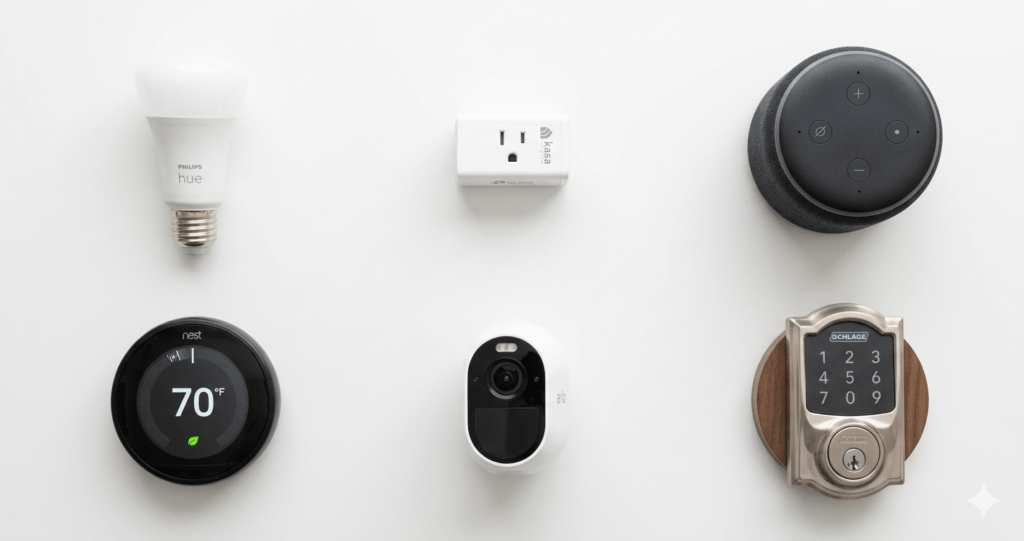
Quick Answer: Yes — you can mix brands in 2026, and it is easier than it has ever been. Most major smart home devices work with Amazon Alexa and Google Home simultaneously. Matter-certified devices go further: they work with Alexa, Google, Apple HomeKit, and Samsung SmartThings all at the same time. The era of being locked into one brand is ending.
The fear of smart home brand lock-in is one of the most common reasons people delay building a smart home. They worry about choosing the wrong ecosystem, buying devices that will not work together, and ending up with an expensive collection of incompatible gadgets that require three different apps and respond to four different wake words.
That concern was entirely justified in 2018-2022. Smart home ecosystems were genuinely fragmented and incompatible. A Philips Hue bulb would not work with a SmartThings hub. A Nest thermostat would not talk to an August lock without a workaround. Mixing brands meant managing multiple apps, accepting reduced functionality, and accepting that some automations simply would not work across ecosystems.
In 2026, the situation has changed significantly — primarily because of Matter, the universal smart home standard that launched in late 2022 and has been expanding rapidly. This guide tells you exactly what is possible today, where frustrations still exist, and how to build a mixed-brand smart home that actually works.
1. The Short Answer: Yes, With Important Conditions
You can mix brands. The conditions that determine how well it works:
- Both devices need to support the same voice assistant (Alexa OR Google Home OR Apple HomeKit) to be controlled together by voice
- Devices from different brands that both support the same voice assistant will appear in the same app and respond to group commands
- Matter-certified devices from any brand work together regardless of manufacturer, app, or original ecosystem
- Automations across brands (if X happens in Brand A, do Y in Brand B) require a shared hub or voice assistant that supports both
- Some specific features — brand-specific scenes, manufacturer-only integrations, premium subscription features — remain within single ecosystems
2. How Smart Home Ecosystems Work (Plain English)
A smart home ecosystem is a platform — software, cloud servers, and a common app — that allows devices from multiple manufacturers to be controlled together. Think of it like a common language: if your lock, bulbs, and thermostat all “speak” the same ecosystem language, they can be controlled together, grouped, and included in the same automations.
The three major ecosystems in 2026 are Amazon Alexa, Google Home, and Apple HomeKit. Each has its own app, its own compatible device library, and its own smart speaker/display hardware. A device that works with Alexa appears in the Alexa app and responds to voice commands through Echo devices. A device that works with Google Home appears in the Google Home app and responds to Google Nest speakers.
Most major smart home brands support both Alexa and Google Home — meaning their devices appear in both apps and respond to both voice assistants. Apple HomeKit has historically had the smallest compatible device library because its certification requirements are stricter, but Matter is rapidly expanding this.
3. The Big Three Ecosystems: Alexa, Google, Apple
| Factor | Amazon Alexa | Google Home | Apple HomeKit |
| Device compatibility | Widest — 100,000+ devices | Wide — most major brands | Smaller but growing via Matter |
| Best for | Most beginners, pure smart home | Android/Google users | iPhone users, privacy focus |
| Voice recognition | Best for smart home commands | Best for information | Best for Apple device users |
| Hub device | Amazon Echo range | Google Nest range | HomePod mini, Apple TV 4K |
| Automation depth | Excellent — Alexa Routines | Good — Google Automations | Good — Apple Shortcuts |
| Privacy approach | Cloud-processed | Cloud-processed | On-device where possible |
| Matter support | Yes (controller + hub) | Yes (controller + hub) | Yes (controller + hub) |
| Offline capability | Limited — cloud dependent | Limited — cloud dependent | Better — local processing |
4. Which Brands Work With Which Ecosystems?
| Brand / Device | Alexa | HomeKit | Matter | Notes | |
| Philips Hue | Yes | Yes | Yes | Yes | Most complete ecosystem support of any brand |
| TP-Link Kasa | Yes | Yes | No | Some | Excellent Alexa/Google, HomeKit via Matter only |
| Wyze | Yes | Yes | No | No | No HomeKit — Android/Alexa households only |
| Govee | Yes | Yes | No | No | No HomeKit or Matter currently |
| LIFX | Yes | Yes | Yes | No | Best Wi-Fi HomeKit option without hub |
| Nanoleaf | Yes | Yes | Yes | Yes | Full Matter support — all ecosystems |
| Schlage | Yes | Yes | Yes | Yes | Encode Plus: full Matter + HomeKit |
| August | Yes | Yes | Yes | No | Good cross-ecosystem but no Matter yet |
| Wyze Lock | Yes | Yes | No | No | No HomeKit — Alexa/Google only |
| Google Nest Therm. | Yes | Yes | No | No | Works with Alexa despite being Google brand |
| Ecobee | Yes | Yes | Yes | No | Best thermostat for HomeKit users |
| Reolink | Yes | Yes | No | No | Alexa/Google only — no HomeKit |
| Eufy | Yes | Yes | Yes | Some | Growing Matter support, good HomeKit |
| Arlo | Yes | Yes | Yes | No | Full ecosystem support for cameras |
| Amazon Echo | Yes | No | No | Yes | Alexa native — controller for Matter devices |
| Google Nest Hub | No | Yes | No | Yes | Google native — Thread Border Router |
| Apple HomePod mini | No | No | Yes | Yes | HomeKit native — Thread Border Router |
5. Matter: Why 2026 Is the Year Brand Mixing Became Easy
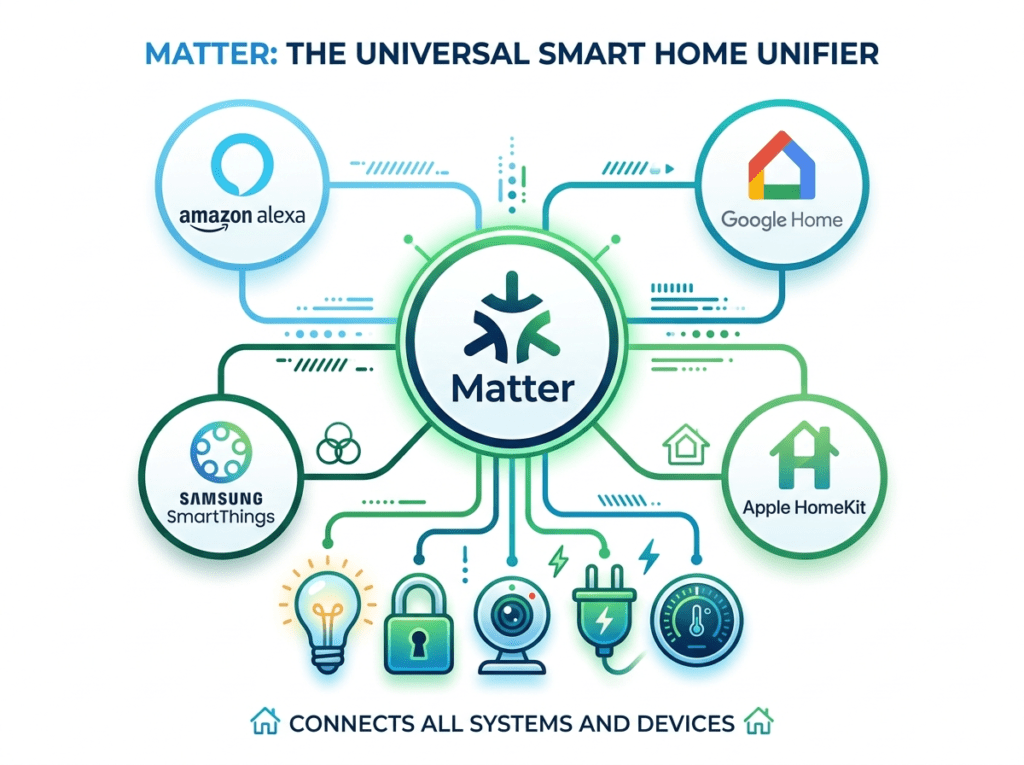
Matter is the smart home industry standard created by the Connectivity Standards Alliance — a consortium including Apple, Amazon, Google, Samsung, and over 280 other companies. Its purpose is simple: allow any Matter-certified device to work with any Matter-compatible controller, regardless of manufacturer.
A Matter-certified smart lock from Schlage works with Amazon Alexa, Google Home, Apple HomeKit, and Samsung SmartThings simultaneously. Not one of them — all four, at the same time, with the same features available on all platforms. You can control the same lock from your iPhone using Apple Home, from an Echo using Alexa, and from a Google Nest Hub. All of them work.
This is genuinely new. Before Matter, a HomeKit-compatible lock would not work with Alexa without a workaround. Before Matter, buying a Wyze camera meant accepting that it would never work with Apple Home. Matter eliminates these hard ecosystem boundaries for all certified devices.
The Matter Check: When buying any new smart home device in 2026, look for the Matter logo on the packaging or product page. If it has Matter, it works everywhere. If it does not have Matter, check which specific ecosystems it supports before purchasing.
6. The Best Mixed-Brand Smart Home Combinations in 2026
Best Mix for Most Households: Kasa + Schlage + Reolink + Echo
Kasa smart bulbs and plugs for lighting and energy management (Alexa and Google compatible), Schlage Encode Plus smart lock (Matter-certified, works everywhere), Reolink cameras for security (Alexa and Google compatible), and Amazon Echo as the central voice control hub. Total cost for a complete setup: $400-600. All devices appear in the Alexa app and respond to a single wake word.
Kasa KL135 Smart Bulbs 4-Pack — ~$55-65
Schlage Encode Plus — Matter certified, works with all ecosystems — ~$200-250
Reolink Argus 4 Pro — compatible with Alexa and Google — ~$90-110
Best Mix for Apple Households: LIFX + Schlage + Eufy + HomePod mini
LIFX smart bulbs (native HomeKit via Wi-Fi, no hub), Schlage Encode Plus lock (Matter, full HomeKit), Eufy cameras (HomeKit Secure Video), and Apple HomePod mini as the Thread Border Router and Siri hub. Everything appears natively in the Apple Home app. Total cost: $500-700.
LIFX A19 Wi-Fi Smart Bulb — native HomeKit, no hub needed — ~$35-45 per bulb
Apple HomePod Mini — Thread Border Router for Apple households — ~$90-100
Best Mix for Maximum Flexibility: Philips Hue + Schlage + Arlo + Google Nest Hub
The most ecosystem-agnostic setup available. Philips Hue works with every ecosystem. Schlage Encode Plus is Matter-certified. Arlo cameras support all ecosystems. Google Nest Hub acts as both a Thread Border Router and a Google Home display. This combination works with Alexa, Google, Apple HomeKit, and SmartThings simultaneously — complete flexibility now and for future ecosystem changes.
Philips Hue Starter Kit — works with every ecosystem — ~$70-100
Google Nest Hub 2nd Gen — Thread Border Router + display — ~$90-100
7. Where Brand Mixing Still Causes Problems
Brand-Specific Scene Syncing
Some of the most impressive smart home features only work within a single brand ecosystem. Philips Hue Entertainment Zones — where every Hue light in a room syncs together to match on-screen content — only works with Hue lights, not with Kasa bulbs also in the room. Govee music sync effects do not extend to non-Govee devices. If you want these advanced synchronisation features, you need all the relevant devices in the room to be from the same brand.
Cross-Brand Automations
Setting up an automation that triggers a device from Brand A when a device from Brand B does something requires a shared platform to bridge them. “When the Reolink camera detects a person, turn on the Kasa lights” requires Alexa Routines or Google Home Automations to bridge the two brands. This usually works but has limitations — not all device events are exposed to voice assistant automation platforms, and some brands expose fewer trigger options than others.
Apple HomeKit Limitations With Budget Brands
Apple HomeKit has stricter certification requirements than Alexa or Google Home, which means fewer budget devices support it. Kasa, Wyze, and Govee — three of the most popular and affordable smart home brands — do not support HomeKit directly. For Apple households, the practical device library is smaller, and prices for compatible devices tend to be higher. Matter is gradually solving this, but the transition is not complete in 2026.
Subscription Features Locked to Ecosystem
Some subscription features are ecosystem-specific and do not transfer when you mix brands. Amazon Alexa Together (family monitoring service), Apple HomeKit Secure Video (end-to-end encrypted camera storage), and Google Familiar Faces (face recognition) are all exclusive to their respective ecosystems. Devices from other brands cannot access these premium features even when added to the ecosystem.
8. How to Choose a Primary Ecosystem
Even though brand mixing is increasingly possible, most households benefit from choosing one primary ecosystem as their central control point:
- If you use Android phones and are deeply integrated into Google services — choose Google Home as your primary ecosystem
- If you use iPhone and value privacy and Apple device integration — choose Apple HomeKit as your primary ecosystem with HomePod mini as hub
- If you want maximum device compatibility, the most automation options, and you do not care about Apple specifics — choose Amazon Alexa
- If you are building a complex multi-device smart home with advanced automations — consider Home Assistant as an open-source local hub that bridges all ecosystems
Your primary ecosystem choice determines which hub device you buy, which app you use daily, and which voice assistant you train yourself to use. It does not prevent you from adding devices from other brands — it just means you will control everything through one central app and one wake word.
9. Future-Proofing Your Brand Mix
The smart home landscape in 2026 is still evolving. Buying decisions made now will affect your setup for 5-10 years. Three principles future-proof your brand mix:
Principle 1: Always Buy Matter When Available
Matter-certified devices will remain compatible with future voice assistant versions and new ecosystem entrants regardless of how the smart home industry evolves. Non-Matter devices are tied to their manufacturer cloud — if that cloud changes or the company pivots, your device may lose functionality.
Principle 2: Avoid Deep Proprietary Ecosystem Lock-In
The more your smart home depends on features exclusive to one ecosystem, the more vulnerable you are to that ecosystem changing its terms, discontinuing features, or declining in market relevance. Build around open standards (Matter, Zigbee, Z-Wave) rather than proprietary features where possible.
Principle 3: Keep Your Data Local Where Possible
Devices that process and store data locally — local camera storage, Matter/Thread local processing, Zigbee hub-based systems — remain functional regardless of manufacturer decisions about cloud services. Devices that store all your data in a manufacturer cloud are dependent on that cloud remaining available, affordable, and unmodified for the life of the device.
10. Frequently Asked Questions
Can Alexa and Google Home work together in the same house?
Yes — you can have Echo speakers in some rooms and Google Nest speakers in others, and use both to control the same set of smart home devices. Any device that works with both Alexa and Google Home will appear in both apps and respond to both wake words. The limitation is that automations in Alexa Routines do not trigger on Google Home devices and vice versa — each ecosystem manages its own automation layer. For cross-platform automations, use Home Assistant or IFTTT to bridge them.
Do smart home devices from Amazon work with Apple HomeKit?
Amazon Echo devices themselves do not work with Apple HomeKit. However, smart home devices controlled by Alexa (Kasa bulbs, Ring cameras, etc.) can be added to Apple HomeKit if they are also Matter-certified. The Echo speaker itself uses Alexa — it does not appear in Apple Home. Think of the voice assistants and the devices they control as separate layers: a device can support multiple assistants even if each assistant runs on its own dedicated hardware.
Can I control all my devices from one app?
With a primary ecosystem chosen and all devices added to it, yes — you can control everything from one app. Amazon Alexa app, Google Home app, and Apple Home app all support adding third-party devices and displaying them in a unified device list. The caveat is that brand-specific advanced features (Govee effects, Hue Entertainment, Wyze Cam Plus detection) still require the brand app to access those specific features. For basic on/off, dimming, scheduling, and automations — one app handles it all.
What happens if I mix brands and one company shuts down?
For Matter-certified devices: the device continues working locally through any compatible Matter controller. Manufacturer cloud going away does not affect local functionality. For non-Matter devices: if the manufacturer cloud shuts down, cloud-dependent features stop. Some devices can be rerouted to local processing via Home Assistant but this requires technical knowledge. This is the strongest argument for buying Matter-certified devices — they are not tied to any single company surviving.
Is there a limit to how many brands I can mix?
No technical limit. The practical limit is how many manufacturer apps you are willing to manage for brand-specific features. Each brand needs its own app for setup and advanced features even if daily control happens through Alexa or Google Home. Most households find 2-3 brand apps manageable. Beyond 4-5 different brands, the setup and maintenance overhead starts to outweigh the benefits of brand diversity.
Can I use a smart home hub to manage all brands in one place?
Yes — this is exactly what smart home hubs like Amazon Echo (4th Gen, which has a built-in Zigbee hub), Samsung SmartThings, and Home Assistant are designed for. A central hub acts as a translator between device protocols and ecosystems, allowing automations that span multiple brands. Home Assistant is the most powerful option for multi-brand integration but requires technical knowledge to set up and maintain.
Do devices need to be on the same Wi-Fi network to work together?
Yes — for most smart home devices to communicate with each other and with your voice assistant, they need to be on the same home network. Wi-Fi devices connect to your router. Zigbee and Thread devices connect to a hub or Border Router that is on your network. The important exception is Bluetooth — Bluetooth smart devices communicate directly with your phone without requiring a shared network, but their range is limited to physical proximity.
11. Our Recommendation
Mix brands freely in 2026 — the compatibility landscape has improved dramatically and will continue improving as Matter adoption expands. The practical approach for most households:
- Choose one primary ecosystem for daily control (Alexa for most people, Google if you are Android-first, Apple if you are iOS-first)
- Buy Matter-certified devices wherever you have a choice between equivalent options at similar prices
- Accept that some brand-specific features require the brand app — this is normal and does not break the overall system
- For cross-brand automations, use Alexa Routines or Google Home Automations — they handle the majority of real-world use cases
- Avoid deep investment in premium ecosystem-exclusive subscription features if you want flexibility to change direction later
The smart home of 2026 is not a walled garden anymore. It is an open field where your thermostat from one brand, your lights from another, your lock from a third, and your cameras from a fourth all work together — controlled by a single voice command, visible in a single app, and orchestrated by automations you set once and forget.
The practical reality: almost any combination of major brand devices you buy today will work together through Alexa or Google Home. The only household for whom brand compatibility is still a meaningful frustration is the Apple-first household — and Matter is solving that faster than any previous initiative in smart home history.
You Might Also Like

Priya holds a background in cybersecurity and brings a technical eye to every camera, doorbell, and smart lock review, specializing in privacy and encryption.
All articles by Priya →