
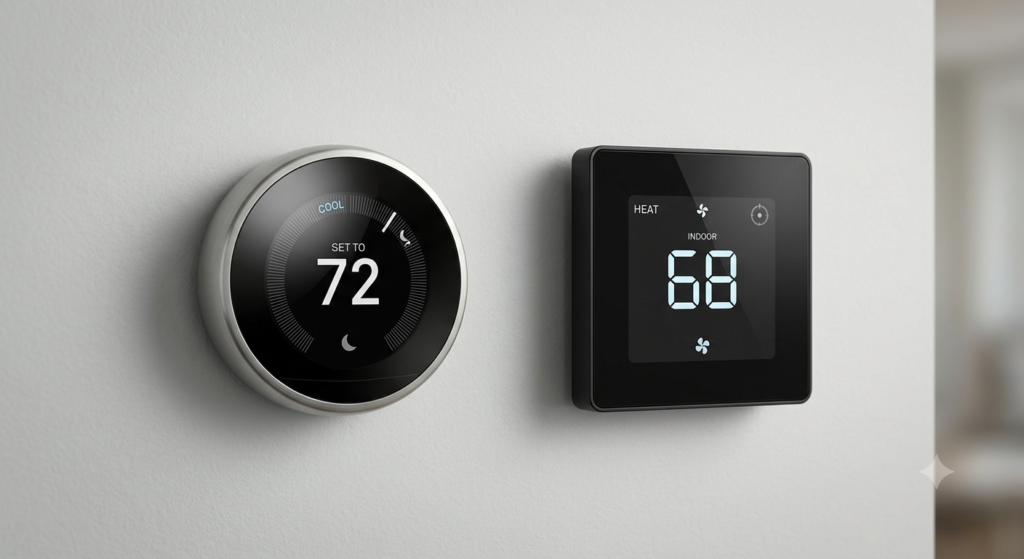
Quick Answer: Ecobee is best for whole-home comfort because it includes room sensors that balance temperature across multiple rooms and has a built-in smart speaker. Nest is best for simplicity and design — it learns your schedule automatically and has the cleaner, more iconic look. Both save roughly the same on energy bills (10-15%). Choose Ecobee if you have rooms that run hot or cold; choose Nest if you want the simplest, most attractive set-and-forget thermostat.
1. The Quick Verdict
Nest and Ecobee are the two best smart thermostats available, and both deliver similar energy savings of around 10-15% on heating and cooling bills. The difference is in how they achieve comfort and what extra features they include. Ecobee bundles room sensors that solve the common problem of some rooms being too hot or cold. Nest focuses on elegant simplicity and automatic schedule learning.
Neither is objectively better — they suit different homes and preferences. This guide breaks down exactly where each one wins so you can match the right thermostat to your home.
2. Nest vs Ecobee at a Glance
| Factor | Google Nest | Ecobee |
| Best for | Simplicity and design | Whole-home comfort |
| Room sensors included | No (sold separately) | Yes (Premium model) |
| Schedule learning | Yes, automatic | Manual + smart |
| Built-in speaker | No | Yes (Alexa built-in) |
| Design | Round, iconic | Square, modern |
| Energy savings | 10-15% | 10-15% |
| Best voice assistant | Google Assistant | Alexa (built-in) + others |
| Typical price | $100-250 | $130-250 |
3. Energy Savings Compared
Both thermostats deliver similar energy savings — studies and manufacturer data consistently show 10-15% reductions in heating and cooling costs for both brands. They achieve this through the same core mechanisms: learning or following your schedule, lowering output when you are away or asleep, and avoiding the waste of conditioning an empty home.
Also read How to save $500 a year with your smart thermostat
Nest leans on automatic learning — it observes your behaviour and builds a schedule for you. Ecobee combines scheduling with its room sensors and occupancy detection to avoid heating or cooling unoccupied rooms. In practice, the savings are close enough that energy efficiency alone should not be the deciding factor — both pay for themselves within 1-2 years through bill reductions.
The Savings Reality: Both Nest and Ecobee typically save $130-300 per year on energy bills, paying back their purchase price within 1-2 years. The energy savings are comparable — choose based on features and comfort, not on savings differences, because there is no meaningful gap.
Google Nest Thermostat — automatic schedule learning — ~$100-130
Ecobee Smart Thermostat Premium — room sensors included — ~$180-220

4. Room Sensors: Ecobee Biggest Advantage
This is the single most important difference between the two. A traditional thermostat measures temperature only at its own location — usually a hallway — which means a bedroom at the far end of the house might be several degrees colder while the thermostat reports the home is at the right temperature.
Ecobee solves this with room sensors. These small wireless sensors placed in different rooms report their temperature and detect occupancy, allowing the thermostat to prioritise comfort in the rooms you are actually using. The Ecobee Premium includes a sensor in the box; additional sensors can be added. For homes with rooms that consistently run hot or cold, this feature alone justifies choosing Ecobee.
Nest does offer temperature sensors sold separately, but they are not included by default and the integration is less central to how Nest works. If even temperature across multiple rooms matters to you, Ecobee has the clear advantage.
Ecobee Smart Thermostat Premium — includes room sensor for even temperatures — ~$180-220
5. Design and Display
Nest is the design icon of the smart thermostat world. Its round form, premium materials, and the way the display lights up as you approach have made it the most recognisable thermostat on the market. For many buyers, the Nest simply looks better on the wall.
Ecobee takes a modern square approach with a sharp full-colour touchscreen. It is attractive and highly functional, with more information displayed at a glance, but it lacks the iconic simplicity of the Nest. If aesthetics are a priority, most people prefer the Nest look — though this is entirely subjective.
6. Smart Features and App
Both apps are polished and capable, offering remote control, scheduling, energy reports, and smart home integration. Ecobee adds a significant bonus: a built-in smart speaker with Alexa on the Premium model, meaning the thermostat doubles as a voice assistant. You can ask it questions, control other smart devices, and play audio directly from the thermostat.
Also read Best smart thermostats for 2026
Nest keeps things focused on thermostat functions with deep Google Assistant integration but no built-in speaker. If you want your thermostat to also act as a smart speaker, Ecobee Premium delivers that; if you prefer a dedicated, focused thermostat, Nest is cleaner.
7. Ecosystem and Voice Assistant Support
| Feature | Google Nest | Ecobee |
| Google Assistant | Native | Yes |
| Amazon Alexa | Yes | Built-in + native |
| Apple HomeKit | No | Yes |
| Samsung SmartThings | Yes | Yes |
| Best ecosystem fit | Google homes | Apple + Alexa homes |
Ecobee has broader ecosystem support, notably including Apple HomeKit which Nest lacks. For Apple households, this makes Ecobee the natural choice. For Google-centric homes, Nest integrates most seamlessly. Both work well with Alexa, though Ecobee Premium has Alexa built directly in.
8. Installation and Compatibility
Both thermostats are designed for DIY installation and work with most common home heating and cooling systems. The key compatibility factor is the C-wire (common wire). Ecobee includes a Power Extender Kit that allows installation without a C-wire in many homes. Nest is also flexible but C-wire requirements vary by model and system.
Before buying either, check compatibility with your specific system using the manufacturer online compatibility checker. For homes without a C-wire, Ecobee included Power Extender Kit gives it a slight installation advantage.
Renters Note: Both thermostats can be installed by renters, but always get landlord permission first since installation involves your heating system wiring. The original thermostat can be reinstalled when you move, so the smart thermostat goes with you.
9. Which Should You Choose?
Choose Nest if:
You want the simplest, most attractive thermostat that learns your schedule automatically, you are in a Google-centric smart home, and your home does not have significant hot or cold room problems. Nest is the set-and-forget choice with iconic design.
Google Nest Thermostat — best for simplicity and design — ~$100-130
Choose Ecobee if:
You have rooms that run hot or cold and want even temperatures throughout your home, you want a thermostat that doubles as an Alexa smart speaker, or you use Apple HomeKit. The included room sensor makes Ecobee the better choice for whole-home comfort.
Ecobee Smart Thermostat Premium — best for whole-home comfort — ~$180-220
10. Frequently Asked Questions
Does Nest or Ecobee save more on energy bills?
Both save roughly the same — around 10-15% on heating and cooling costs, typically $130-300 per year. The savings difference between them is negligible. Both pay for themselves within 1-2 years. Choose based on features and comfort rather than energy savings, since there is no meaningful gap.
What is the main difference between Nest and Ecobee?
The main difference is room sensors. Ecobee includes wireless room sensors that balance temperature across multiple rooms and detect occupancy. Nest focuses on automatic schedule learning and iconic design without included room sensors. If you have rooms that run hot or cold, Ecobee solves that; if you want simplicity, Nest is cleaner.
Does Ecobee work with Apple HomeKit?
Yes — Ecobee works with Apple HomeKit, which is a notable advantage since Google Nest does not support HomeKit. For Apple households, Ecobee is the natural choice because it integrates with the Apple Home app and Siri.
Which is easier to install, Nest or Ecobee?
Both are designed for DIY installation. Ecobee has a slight edge for homes without a C-wire because it includes a Power Extender Kit that enables installation in many homes that lack one. Always check compatibility with your specific heating system using the manufacturer online checker before buying.
Does Ecobee really have Alexa built in?
Yes — the Ecobee Smart Thermostat Premium has Amazon Alexa built directly into the device, meaning it functions as a voice assistant and smart speaker in addition to a thermostat. You can ask questions, control smart devices, and play audio from the thermostat itself. Nest does not have a built-in speaker.
Can I use room sensors with Nest?
Nest offers temperature sensors sold separately, but they are not included and the integration is less central than Ecobee. Ecobee Premium includes a room sensor in the box and is built around the room-sensor concept. For multi-room temperature balancing, Ecobee is the stronger choice.
The Bottom Line
Nest and Ecobee are both excellent smart thermostats that save similar amounts on energy bills. Choose Ecobee if whole-home comfort matters — its included room sensors balance temperature across rooms and it doubles as an Alexa speaker. Choose Nest if you want the simplest, most attractive thermostat that learns your schedule and looks iconic on the wall.
For most homes with uneven temperatures, Ecobee edges ahead thanks to its room sensors. For homes that just want a beautiful, simple, effective thermostat, Nest is the classic choice. Either way, you will save money and gain control over your home climate — the decision comes down to whether room-by-room comfort or elegant simplicity matters more to you.
You Might Also Like

Daniel is a certified electrician turned tech writer focused on smart lighting, energy monitoring, and helping homeowners reduce electricity bills with smart tech.
All articles by Daniel →